Seventy-two years ago, Wake athletics hosted a future president and a future Masters champ
Gene Hooks was there the day, 72 years ago, when two of the most famous Americans of their century nearly crossed paths in Raleigh, not that anyone knew it at the time.
Hooks was playing baseball for Wake Forest on the old campus in its namesake town, and at one point he was standing on first base next to Yale’s first baseman, a former Navy pilot named George Herbert Walker Bush.
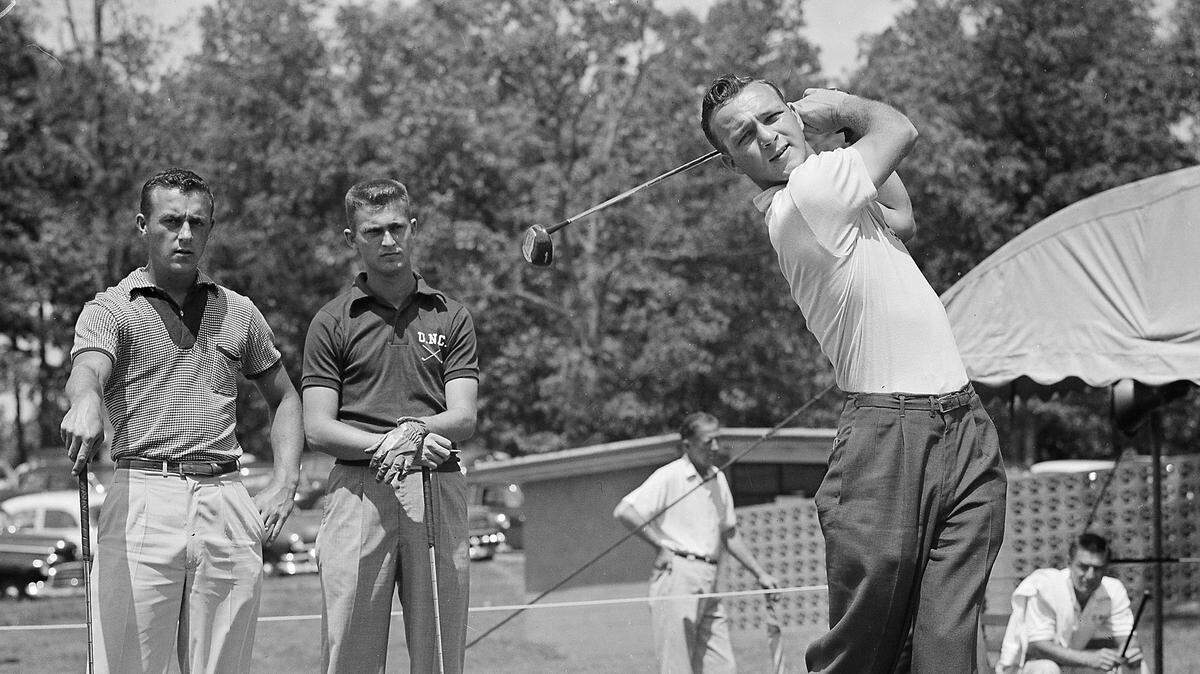
A few miles away in Raleigh at Carolina Country Club, a Wake Forest freshman from Pennsylvania — already one of the more popular students on campus — was playing in his first golf match for the Demon Deacons. Arnold Palmer was the medalist with a 67 against Michigan.
George Bush. Arnold Palmer. Monday, April 5, 1948. An otherwise unremarkable day in Raleigh when the universe shook things up and left an asterisk behind for history to discover years later, a joint visit from the future 41st president of the United States and the most popular golfer ever to swing a club.
“I just wish that I had known when I got on first base,” said Hooks, 91, later the baseball coach and athletic director at Wake Forest after the university moved its campus to Winston-Salem. “I would have talked to him a little bit. I didn’t recognize him being any different from any of the other players.”
There are only a few players from that Wake Forest baseball team alive, and Hooks remembers the game down to his at-bats. It was a big one, a visit from the best team on the East Coast, runner-up in the 1947 College World Series.
Yale threw its ace, junior Frank Quinn, and Wake Forest answered with freshman Harry Nicholas, who the New York Yankees had tried to sign before he graduated from high school and were fined $500 for their trouble. Bush hit seventh for Yale and went 1-for-3. Nicholas threw a three-hitter and struck out 11, outdueling the Yale star in his college debut.
It was, the Old Gold and Black reported, “some of the finest ball ever seen in Baptist Hollow.” The Deacons scored twice in the seventh, all the offense they would need in a 2-0 win.
Across town, Palmer was teeing it up for the Deacons, whose golf team had been a laughingstock until another ACC coach cracked a joke about having Wake Forest caddie for the other teams. Athletic director Jim Weaver — a future ACC commissioner — started looking for players, and his first big recruit was Buddy Worsham, a hotshot from Maryland whose older brother Lew had just won the U.S. Open.
That summer, Worsham and Palmer were playing together in an amateur tournament in Los Angeles when Palmer started complaining that the schools recruiting him were mostly in the north. As Palmer recounted it in 2011, he said he’d like to go somewhere he “could play a little golf.” Worsham, recognizing a kindred spirit, suggested Palmer follow him down to Wake Forest.
“I said, ‘Wake Forest? Where in the hell is Wake Forest?’” Palmer said. “He said, ‘It’s in North Carolina and we could get out and have some fun down there.’”
Did they ever have some fun. Palmer and Worsham were the life of the campus as freshmen, holding court at the Colonial Club restaurant, chipping golf balls over the poolhouse and into the campus pool. By April, the time came for them to actually play a little golf.
Palmer played in the No. 2 position against Michigan and shot a 67. Worsham, playing No. 1 for Wake Forest, shot a 68. The Deacons beat Michigan, the defending Big Ten champions, 22-5.
“They were good,” Hooks said. “And they were very popular. Buddy Worsham and Arnold were a very, very likable pair. And they had already pretty much established themselves as really, really good golfers on a really, really good golf team.”
Wake Forest was a top-10 golf team nationally in 1949 and 1950, but Worsham was killed in a car accident on what is now Highway 98 in the fall of 1950, a tragedy that never left Palmer, who had decided not to go to Durham with Worsham for the homecoming dance. In the wake of Worsham’s death, Palmer left Wake Forest between semesters and joined the Coast Guard, returning to finish his degree (and win an ACC title) in 1954. He later endowed a golf scholarship in Worsham’s name.
Yale would end up going back to the College World Series in 1948, and Hooks would get his shot with Wake Forest in 1949, later becoming one of that school’s most treasured administrators and representatives.
The rest, as far as Palmer’s golf career, occupies many pages of the history books. So did his love for Wake Forest, up to the day he died in 2016.
But Carolina Country Club is still around. So is the old Wake Forest campus, now the Southeastern Baptist Theological Seminary. And so is Hooks, who remembers that game against Yale down to the at-bat, including that two-run seventh.
“I remember it very well,” Hooks said, “because I got a double in that inning.”
This story was originally published April 3, 2020 at 6:00 AM with the headline "Seventy-two years ago, Wake athletics hosted a future president and a future Masters champ."