‘An incredible need.’ Why neighbors are demanding that dredging be allowed on Lake Wylie
York County rules that would stop an industrial company from plopping down between expensive waterfront homes on Lake Wylie are meant to protect homeowners. But that’s not how many neighbors see a dock and dredging company with its sights on Crowders Creek.
“There’s an incredible need for the lake to be dredged,” said John Gossett, one of more than a dozen people who asked York County Council to allow the business Monday night.
Lake Wylie Dock Construction asked to rezone a little more than 1 acre of lakefront property at 5333 Charlotte Hwy. to use as a construction staging area. County staff is against the change. The county Planning Commission voted unanimously against it.
Both had concerns with allowing light industrial zoning on the water, and in a residential area.
Long-time lake resident Ed Lindsey, looking Monday night at a room full of people in support of the dock and dredging business, asked York County Council who they would protect by stopping the rezoning.
“They live there,” Lindsey said. “And they want it.”
Dredging on Lake Wylie
Dredging, or removing sediment from the bottom of a water body, is complicated on Lake Wylie.
Duke Energy manages the lake and has authority on property below the water line. Counties — York in South Carolina along with Mecklenburg and Gaston in North Carolina — make property decisions on the buildable parts of lots above the water.
A dredging permit requires numerous approvals or documents from Duke Energy and state and local governments. Groups from the U.S. Army Corps of Engineers to the Lake Wylie Marine Commission may also be involved, depending on project size.
A typical residential dredge can cost a homeowner five figures, not counting permitting costs. They can take a year or more to complete and have to be scheduled around everything from contractor availability to fish spawn seasons.
Most companies that could dredge on Lake Wylie are based on Lake Norman or elsewhere, homeowners say. That means higher prices here or limited scheduling options.
“This is a sorely needed business on the lake,” said York County Councilman Andy Litten, who took the Dist. 2 seat representing Lake Wylie for the first time Monday after an election win in November.
Some of Lake Wylie’s oldest businesses work in marine construction.
DockMasters, Edwards Grading Service, Clawson’s Pile Driving & Construction and WaterJack Marine Construction have been on the lake for decades. They build docks and stabilize shorelines with rip rap. Some also dredge.
Duke Energy has a list of contractors for homeowners looking for dock, shoreline or other work on the water. Of 47 contractors listed for the Catawba River basin, only eight are based on Lake Wylie. Most come from Charlotte or the Lake Norman area.
Dirt and trees fill Crowders Creek
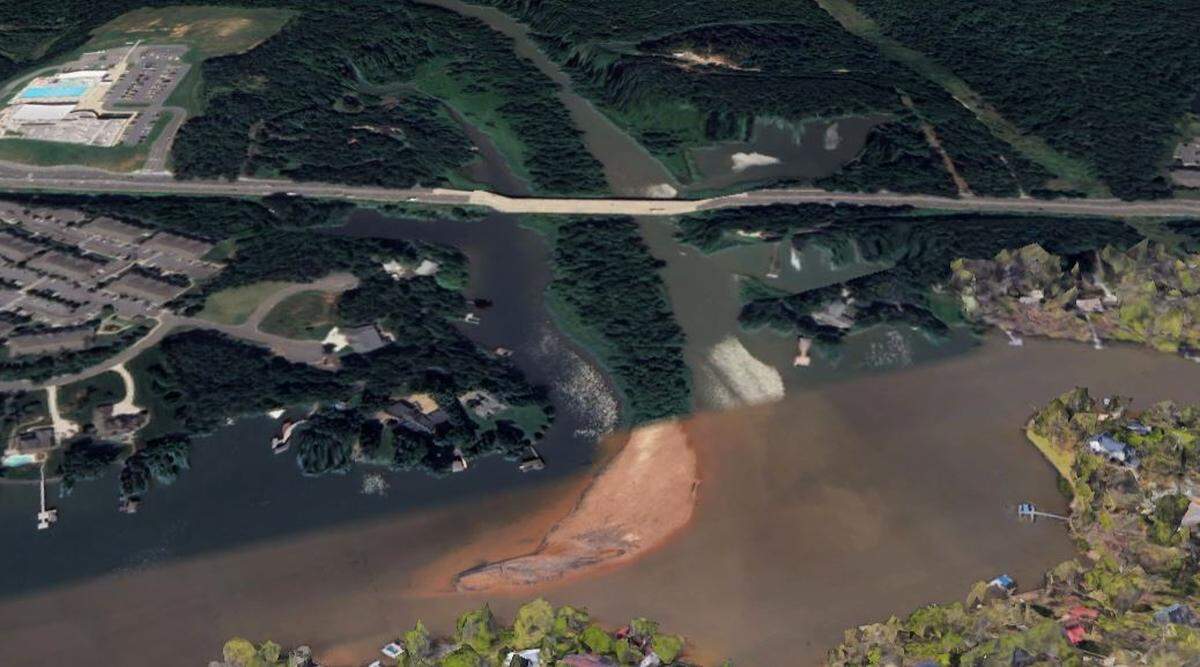
Drive the Crowders Creek bridge on S.C. 49, and it looks like two creeks — one on either side of a long stretch of trees that reach out toward the main channel of Lake Wylie. Before decades of sedimentation, Crowders Creek was a large cove that fed the lake.
“In 25 years, that’s grown up 30-foot trees and 200 yards of silt,” said long-time property owner Michael Cox.
Lindsey recalls the once popular public boat launch just north of the bridge. “People jumped off the bridge,” he said. “People went water skiing under the bridge. I have a floating dock that no longer floats. It’s on dirt because of the silt coming down.”
Several residents in that area say they’re landlocked now, or close to it. Some can get a canoe or kayak in, but not a docked boat.
“If there’s a slight drought, you could put waders on and get off at the bridge and just walk your way all the way down the lake, down the middle,” said resident John Gossett.
Crowders Creek is a stark example of that, and it’s right where Lake Wylie Dock Construction wants to put its business. But there are other coves from Belmont to Allison Creek in Rock Hill facing similar fill-in.
“It’s not just with this section of the lake,” said Lake Wylie Dock Construction owner Todd Flowers. “It’s for the entire lake.”
As a kid, Gossett played in areas with boat landings that he can only paddle to now with his kids, he said. “It’s a shame when you can remember what that section of lake used to be,” he said, “and what it has become.”
Rezoning concern on Lake Wylie
Though residents largely welcome a dredging business, concerns remain.
Councilman Watts Huckabee bought a lake house in 2008 when he could put a boat in, and he can’t now after more than a foot of sediment filled in, he said. Still, he has concerns with how dredging would impact that area near homes and wonders if there’s a better spot.
Though he supports dredging, he also doesn’t see it as the wonder solution to all the lake’s problems.
“Dredging is not a permanent solution,” Huckabee said. “You’re going to dredge again. It’s like painting your house.”
Lake Wylie resident Kris Frazier offered an admittedly unpopular take on Monday, as the lone person from Lake Wylie opposing the rezoning. Frazier understands the need and would be one of the first people to call the business if it comes, she said, but there’s still the issue of nearby homes.
“We need that service here, locally, with one of our neighbors,” Frazier said. “What I am against is the location.”
Then, there’s the light industrial issue.
Councilwoman Debi Cloninger represents District 7, where one of the more contentious land use decisions in recent memory is ongoing.
Silfab Solar wants to produce solar panels on Logistics Lane property in Fort Mill that’s zoned for light industrial use. Neighbors argue it could harm neighborhoods and schools beside it. York County decisions related to Silfab are part of ongoing litigation to decide what the company can do.
Changing zoning to allow the dredging business may suit neighbors now, Cloninger said, but it might not later if the property changes hands or uses.
She thinks about the home she bought on a golf course assuming it would always be there, only to have it sold and developed as townhomes and apartments. Light industrial in particular, Cloninger said, is a serious decision due to the types of manufacturing it could allow.
“When you ask us to change the zoning of your (property),” she said, “you are truly opening up a can of worms.”
Decision coming to change zoning
Council heard from neighbors worried the fire boats can’t access homes due to shallow water, or a $200,000 property value drop between comparable homes in the area due to dock access.
They heard from a resident who can’t use her dock four years after moving to the lake.
Council also heard from staff whose land use maps project residential growth there, and say it doesn’t fit with roads and neighborhoods. Staff noted the ongoing Merriway Pointe subdivision which will bring hundreds of homes, including nine lots on the same cove just across from the dredging site.
Council voted 6-1 to change the zoning on Monday, but two more votes are needed to complete it. Huckabee was the lone vote against.
Council asked for more information on existing Lake Wylie dredging businesses and other sites where a dredging company might fit better, ahead of those votes.
There was discussion about a deed restriction that might limit other industrial uses on the property. But for now, Council appears set to make a zoning change they wouldn’t allow, except for the business most of them feel is too good to pass up.
With all the homes and marinas on Lake Wylie, Litten doesn’t know where else a dredging business could go on the water. And erosion is one of the biggest, longest-running threats to the lake.
It’s a threat to boaters too, Litten said, especially after Hurricane Helene.
“After the hurricane, there are numerous areas that silted in and have sandbars now that aren’t on any maps, that you’re only going to find by accident,” he said.
Zoning rules are meant to protect property owners. That’s what Councilman Tom Audette sees in rezoning the property to allow a dredging company.
“When people buy homes on the lake,” Audette said, “they expect to actually be able to access the lake. It’s critical for your property values.”
This story was originally published January 8, 2025 at 6:12 AM.