Could proposed new homes block the path of Dave Lyle Boulevard extension?
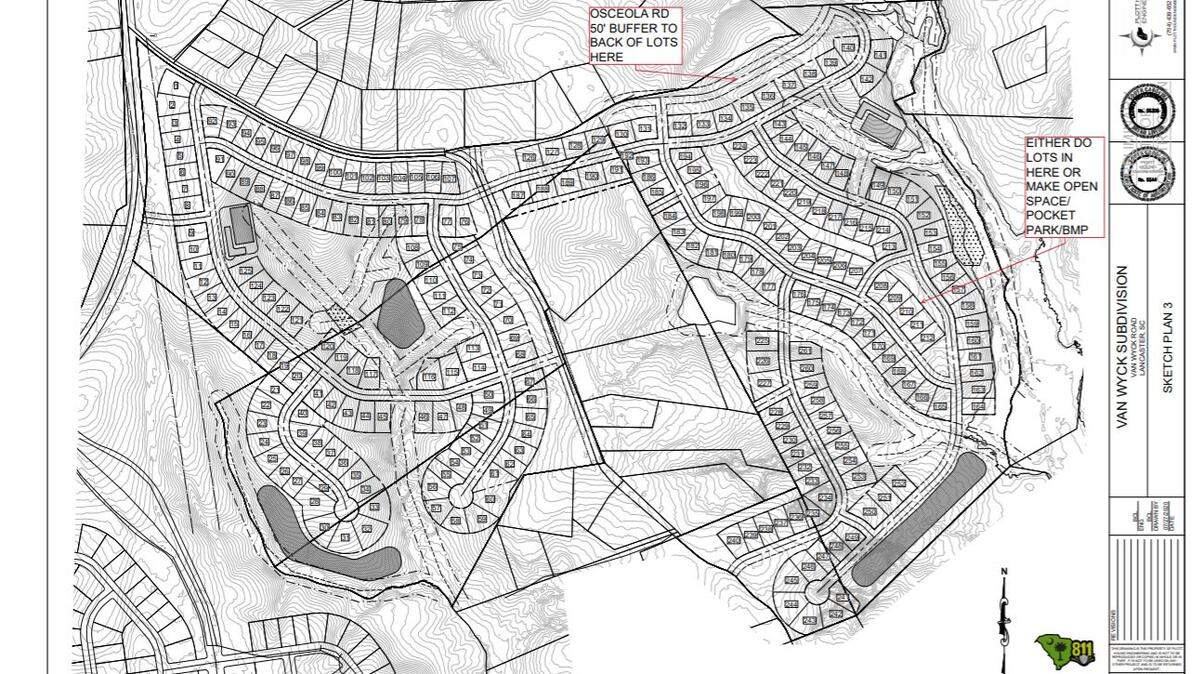
A proposed panhandle development could add a couple hundred more homes in northern Lancaster County, but its impact could reach beyond that area.
Henderson, Nevada-based Carolina Ventures 1 LLC has applied for a zoning change for 155 acres identified as “Van Wyck Subdivision” in Lancaster County.
The proposed development would go in the likeliest spot for what one-day could be the Dave Lyle Boulevard extension.
The property includes five land parcels near Griffin, Osceola and Van Wyck roads. The property is just north of the Tree Tops development, between Van Wyck Road and a tributary to Twelve Mile Creek. It’s a little more than a quarter mile from Sun City and a mile from the Catawba River.
A sketch plan submitted with the application shows 261 new-home lots. They line both sides of new roads, with three cul-de-sacs. The central portion of the property is shown as open space.
The county planning commission will take up the zoning change proposal Sept. 15. With a recommendation for, or against, from the planning commission, Lancaster County Council will have the final say.
Part of the decision involves a potential road discussed for decades.
Dave Lyle Boulevard
Dave Lyle Boulevard connects the downtown Rock Hill area with large retail areas in and around the Rock Hill Galleria mall.
The boulevard ends just south of Waterford Golf Club, which the Carolina Panthers bought earlier this year along with land just off I-77 as part of it’s planned headquarters in Rock Hill by 2023.
The land is mostly rural from where Dave Lyle ends to the Lancaster County line -- at the Catawba River.
Talk of a Dave Lyle Boulevard extension into Lancaster County predates many of the more established stores now along the road. A Herald opinion piece from 2007 notes civic, public and commerce officials who supported the extension.
That 2007 article also referenced a study that predicted the extension would generate $277 million-$359 million in retail revenue by capturing shopping traffic that now goes into North Carolina. York County owns the land along the Catawba River with plans for a Riverbend Park similar to the Anne Springs Close Greenway in Fort Mill.
In 2008, York and Lancaster counties agreed to split the $150,000 cost for a study on the extension. By 2014 York County leaders still hadn’t received answers for an state application to the infrastructure bank and other efforts to help pay for the then-estimated $225 million project.
The Rock Hill-Fort Mill Area Transportation Study lists the Dave Lyle extension on its long-range plan. RFATS members include elected officials from York and Lancaster counties.
The Dave Lyle extension occasionally comes up in policy committee conversation related to economic development and as a way to help with traffic congestion.
A recent RFATS collector street plan shows a potential route for the extension going south from its endpoint, roughly parallel with South Dobys Bridge Road in Fort Mill, to the Catawba River near where York County owns the Riverbend park property. The map shows the Dave Lyle extension running south of Sun City before linking with Waxhaw Highway at U.S. 521.
Nothing in that RFATS map is official in terms of route, or even that the road will happen.
“It is still on the RFATS long-range plan, but there is zero funding on it,” said Lancaster County Councilman Brian Carnes, an RFATS policy committee member. “Barring it getting approved by the (state) infrastructure bank or something like that, I don’t see it happening anywhere in the near future. It’s such an expensive project.”
The last estimate Carnes recalls for the extension came about eight years ago, at well more than $200 million.
Roads through home subdivisions
Roads often take years, sometimes decades, to get completed. A changing landscape, particularly with new home subdivisions, has often become an issue.
One example was a proposal for a new Catawba River bridge crossing from Rock Hill to Fort Mill. Rock Hill leaders wanted the bridge because it would ease Celanese Road congestion. Fort Mill leaders didn’t want it because they feared more traffic on Sutton Road.
That bridge came with a high price tag that could’ve taken RFATS funding for a decade or longer.
That led to five years of debate before it was voted down. And toward the end of debate there were new Fort Mill subdivisions along the Catawba in places where the bridge could’ve gone.
U.S. Rep. Ralph Norman, a state representative and RFATS member during those bridge discussions, said then it was difficult to secure funding for expensive roads without an ability for business to build around them and create revenue.